“Bad, but Used to It”: From Resignation to Educational Innovation
Why so many institutions stay on learning platforms that don’t serve them, and a simple, low-risk way to break the inertia and modernize.
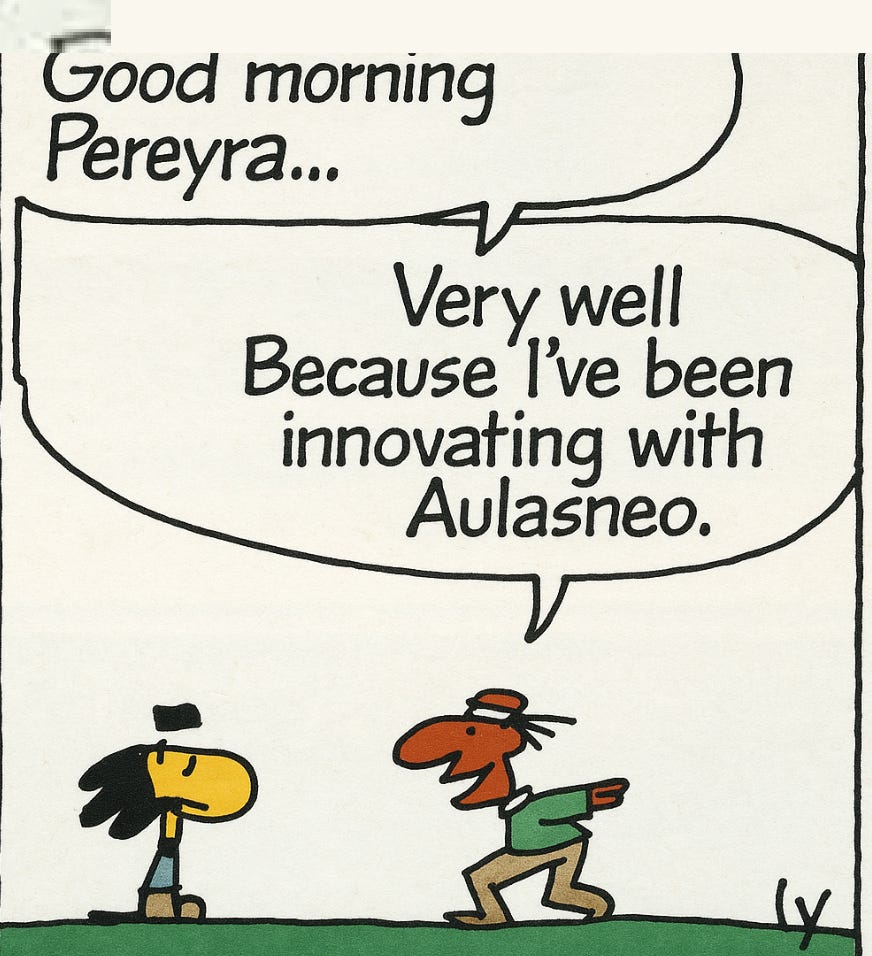
In a well-known Argentine comic strip published in Clarín’s Sunday magazine, there was a very peculiar character: Inodoro Pereyra. He was a parody of the Pampas gaucho, inspired by Martín Fierro — a lone philosopher who, from his humble ranch and alongside his loyal dog Mendieta, reflected on life with humor and irony.
One of his sayings stuck with me since childhood. When someone asked how he was doing, he’d answer with dry honesty:
Many attendees nodded as we described the commonpain points at the intersection of education and technology:
Poor user experience in many learning platforms.
Infrastructure failures during peak academic demand (“the platform crashed!”).
Limited visibility and analytics, often dependent on endless Excel spreadsheets.
Manual and repetitive tasks, like enrollments, content uploads, or grading.
What surprised me was how many people related to these issues — and how few had found real solutions.
Some told me, “We really like what you’re proposing, but… it’s hard.”
The “bad but used to it” syndrome
That’s when Inodoro Pereyra came to mind again. Many educational institutions today are living exactly like that — bad, but used to it.
They rely on outdated platforms that confuse learners and burden instructors with administrative work.
Technology, instead of enabling better teaching, ends up getting in the way.
Why does this happen?
There are many reasons — and all of them deeply human:
Political factors: How do you tell a dean that the platform they chose and invested in creates a poor student experience?
Mindset barriers: “The platform is just a repository; our real strength lies in our buildings and our brand.”
Lack of technical teams: Institutions choose what others use, instead of assessing their own needs.
Resistance to change: “I’m bad, but used to it. Why risk being better?”
Breaking the inertia
Change doesn’t have to be disruptive or risky.
A simple and effective way to move forward is by running a pilot — choosing one specific course or program (for example, a corporate training within a university) and delivering it on a modern platform like Open edX.
This approach allows institutions to:
Evaluate the real experience of teachers and learners.
Test integrations, design, and analytics with minimal risk.
Build internal momentum once the positive results speak for themselves.
At Aulasneo, we see it again and again: after that first pilot, word of mouth takes over. More courses follow, innovation spreads, and transformation begins.
A closing thought
So, in this edition of Spark Learning, my invitation is simple: dare to experiment. Don’t settle for low-value or outdated solutions. Break free from the bad but used to it mindset and step into a more modern, efficient, and human way to learn and teach.
—Good morning, Pereyra. How are you doing? —Very well! I’m innovating, together with Aulasneo.
That’s why, if you find yourself identifying with that “bad but used to it” feeling, now is the time to change it.
Educational technology should never be an obstacle — it should be an ally that enhances teaching, simplifies processes, and creates memorable learning experiences.
At Aulasneo, we help institutions take that leap toward modernization.