Artificial intelligence has moved beyond the hype cycle. It has become part of everyday work.
Companies are building copilots, universities are experimenting with AI tutors, governments are exploring automation, and teams across every industry are creating internal AI applications faster than ever before.
That is exciting.
But it is also creating a new organizational challenge.
The biggest risk with AI isn’t making mistakes. It’s investing heavily—and learning very little.
Across organizations, we keep seeing the same pattern. Marketing adopts one AI platform. HR experiments with another. Engineering builds internal agents. Finance automates reporting. Operations develops workflow automations.
Individually, every initiative makes sense.
Collectively, however, they often lead to duplicated efforts, fragmented knowledge, rising operating costs, and very little understanding of what is actually creating long-term business value.
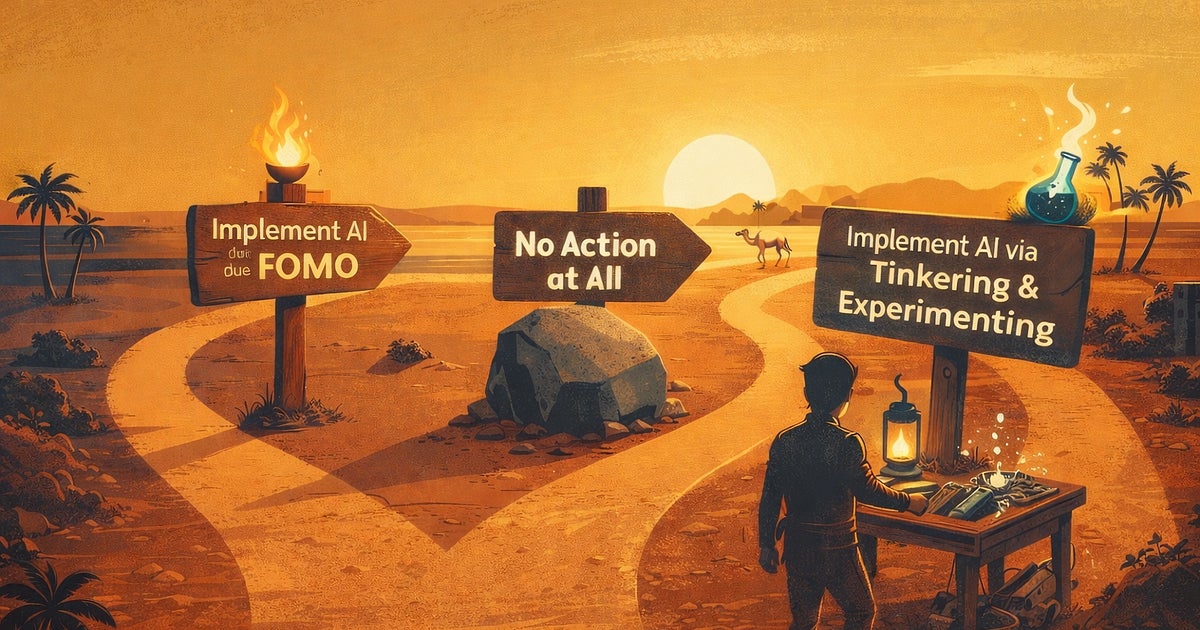
Fear of Missing Out (FOMO) certainly accelerates this behavior.
But FOMO isn’t the real problem.
The real problem is that many organizations are experimenting with AI without developing the organizational capability to learn from those experiments.
Competitive advantage is no longer about adopting AI.
It’s about learning faster than everyone else.
One of the biggest misconceptions surrounding AI adoption is that success comes from running as many pilots as possible.
Our experience suggests exactly the opposite.
The organizations creating the greatest value from AI aren’t running more pilots. They’re learning more from every experiment.
Over the past few years, this observation has evolved into a methodology we now call The Spark AI Learning Loop™.
It is not an implementation process.
It is a framework for building an organizational capability: turning AI experimentation into continuous learning.
Every initiative should leave behind two outcomes.
The first is measurable business impact.
The second is organizational knowledge that makes every future initiative better than the last.
Organizations that consistently produce both begin to compound their learning. Those that don’t simply accumulate disconnected AI projects.
Five capabilities of an AI-native organization
The Spark AI Learning Loop™ is built around five organizational capabilities.
Prioritize
Choose the business problems that matter most. Not every challenge requires an AI solution.
Experiment
Validate ideas through focused, low-risk initiatives with clear hypotheses. Experimentation should be intentional—not improvised.
Measure
Evaluate business outcomes, not just technical performance. The important question isn’t whether the model produced a correct answer. It’s whether it created meaningful value.
Learn
Capture, document and share what every initiative teaches the organization. Learning should never remain inside a single team.
Scale
Transform successful experiments into sustainable organizational capabilities.
Then begin the cycle again.
Because competitive advantage no longer comes from adopting technology first.
It comes from learning faster than everyone else.
The conversation executives should be having
Many AI discussions revolve around models, prompts, benchmarks and new tools.
Those conversations are useful.
But they are rarely the most strategic ones.
A much more important question is:
What will it actually cost us to operate AI three years from now?
That cost extends far beyond API usage or tokens—the units used by most AI providers to bill their services.
It also includes people, training, governance, security, infrastructure, integrations, vendor dependency, maintenance and continuous improvement.
AI is rapidly becoming operational infrastructure.
The architectural and governance decisions organizations make today will likely shape their capabilities for years to come.
Governance matters more than technology
Technology evolves incredibly fast.
Organizations evolve much more slowly.
That is precisely why governance is becoming one of the most important competitive differentiators.
Who decides which experiments deserve investment?
Who measures business impact?
Who prevents different departments from solving the same problem twice?
Who decides when an experiment is mature enough to become part of everyday operations?
Which organizational data should AI systems be allowed to access?
Governance is often associated with bureaucracy.
In reality, good governance enables exactly the opposite: faster innovation, better decisions and far less wasted effort.
📚 What does this mean for Education?
Education is entering one of its most significant transitions in decades.
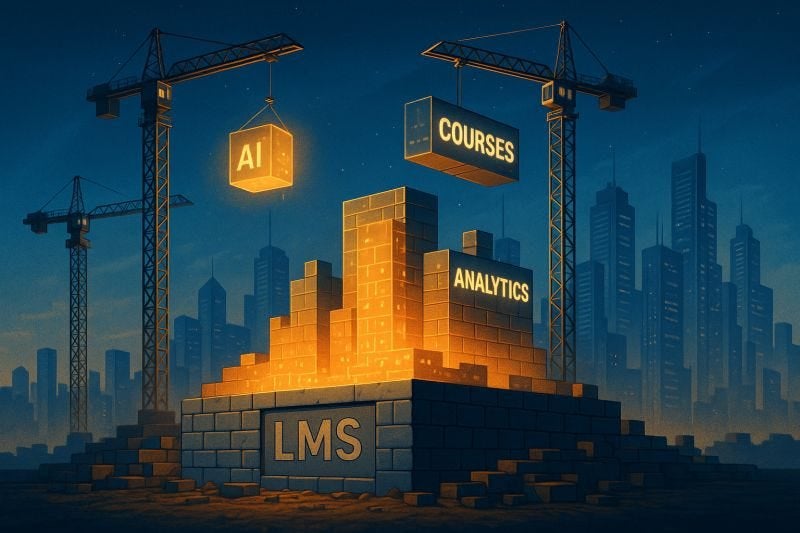
Most Learning Management Systems were designed before generative AI became mainstream. Integrating intelligent capabilities into those platforms is certainly possible, but the larger challenge is no longer technical.
It is strategic.
Today, students and educators already have access to remarkably capable tools such as ChatGPT, Claude, Gemini and NotebookLM.
Institutions no longer control every learning interaction.
Their role is shifting toward designing learning experiences, ensuring academic integrity, defining governance and helping learners develop the judgment required to use AI effectively.
The future is no longer about adding AI to an LMS.
It is about redefining the institution’s role within an AI-native learning ecosystem.
Building capabilities instead of collecting tools
Doing nothing is a risk.
But experimenting without a framework can be just as expensive.
Organizations don’t need more AI applications.
They need a repeatable capability to prioritize opportunities, run disciplined experiments, measure outcomes, capture learning and scale what actually works.
That is exactly what The Spark AI Learning Loop™ is designed to build.
At Aulasneo, we help organizations develop this capability through The Spark AI Learning Loop™ Assessment and collaborative implementation workshops.
Rather than recommending specific AI tools, we help leadership teams understand where they stand today, identify their highest-impact opportunities and build a sustainable roadmap for AI adoption.
In future editions of SparkLearning, we’ll explore each capability of The Spark AI Learning Loop™ in depth, sharing practical implementation patterns, lessons learned and real-world examples from organizations across multiple industries.
And if your organization is ready to move beyond isolated AI experiments, we’d be delighted to help you begin building this capability.
If you want to start The Spark AI Learning Loop™ Assessment for your organization today, let's talk